

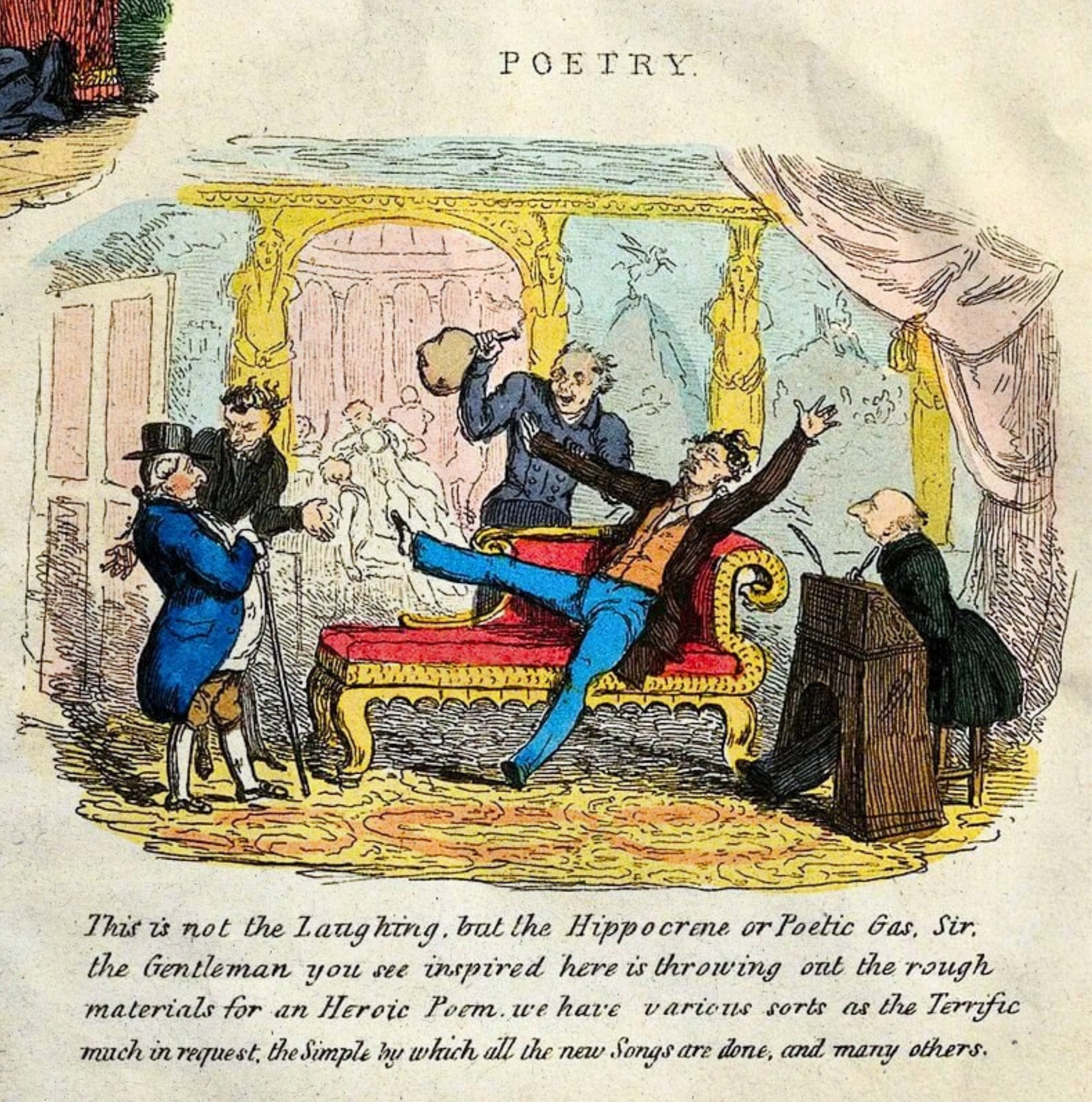
On Medicine Considered as One of the Fine Arts
Friday, October 22nd, 2027
Heyman Center for the Humanities at Columbia
Project leader: Arden Hegele (Columbia)
Collaborators: Lilith Todd (U Penn), Matt Sandler (Columbia), Erik Gray (Columbia)
Description
The relationship of poetry to medicine is an ancient association that intensely preoccupied Keats, Shelley, and their circles. In the Romantic period, as medicine was finding its feet as a standalone academic discipline, writers and poets were taking seriously the notion that literary experimentation might have a measurable effect on transforming human bodies—both of poets and of readers. This conference will explore how the second-generation Romantics—especially Keats, Percy and Mary Shelley, Byron, Hunt, De Quincey, and others—made serious sallies into the history of medicine through their experiments in poetry.
Keats, Shelley, and their circles relished how the porousness between poetry and medicine allowed them to intervene across the two cultures. Keats’ medical training influenced his depiction of neural networks, the “wreath’d trellis of a working brain,” in Ode to Psyche. Shelley was a lifelong experimentalist of the thresholds of the body, undertaking physical trials with electricity, gunpowder, telescopes, and balloons. Byron had an enduring interest in morbid anatomy, attending executions and visiting the anatomical museums of Bologna. At the Palazzo Lanfranchi in Pisa (the residence of Byron and Hunt), Mary Shelley requested an Italian surgeon to perform a secret galvanic demonstration in the basement, informing her revisions to Frankenstein. De Quincey’s 1827 On Murder Considered as One of the Fine Arts—whose bicentenary is in 2027—used satire to explore the relationship between the arts and the burgeoning field of forensics. Meanwhile, Romantic medicine laid the foundations for both early “racial science” and for the pathologizing of divergent mind-bodies through new articulations of “normal.” And today, a long tradition of literary writing by doctors considers Keats as a foundational physician-poet, while the field of Narrative Medicine selects texts by nineteenth-century writers, such as Mary Seacole, as it teaches physicians how to read and listen closely.
This conference, “On Medicine Considered as One of the Fine Arts,” invites high school and undergraduate students, as well as members of the general public, who may be curious about Romantic poetry; physicians and other health providers who are interested in how medicine finds its voice in literature and writing; and, finally, scholars and teachers who wonder, how can the Romantics offer us a model for enriching our own interdisciplinary pursuits today?
Look forward to more details soon!