Members’ Meeting 2026
with a talk from Nicholas Roe:
“Leigh Hunt, Lord Byron, and The Liberal: some Causes and Consequences.”
Friday, May 15, 1pm ET
on Zoom
It’s time for our annual Members’ Meeting!
Please join us for K-SAA updates followed by a K-SAA Digital Event celebrating Nicholas Roe's new book, John Keats and the Perils of Posterity (Oxford, 2025).
His talk will explore the literary and personal fallout between Leigh Hunt and Lord Byron, and the lasting impact of The Liberal in "Leigh Hunt, Lord Byron, and The Liberal: some Causes and Consequences."
About the Event
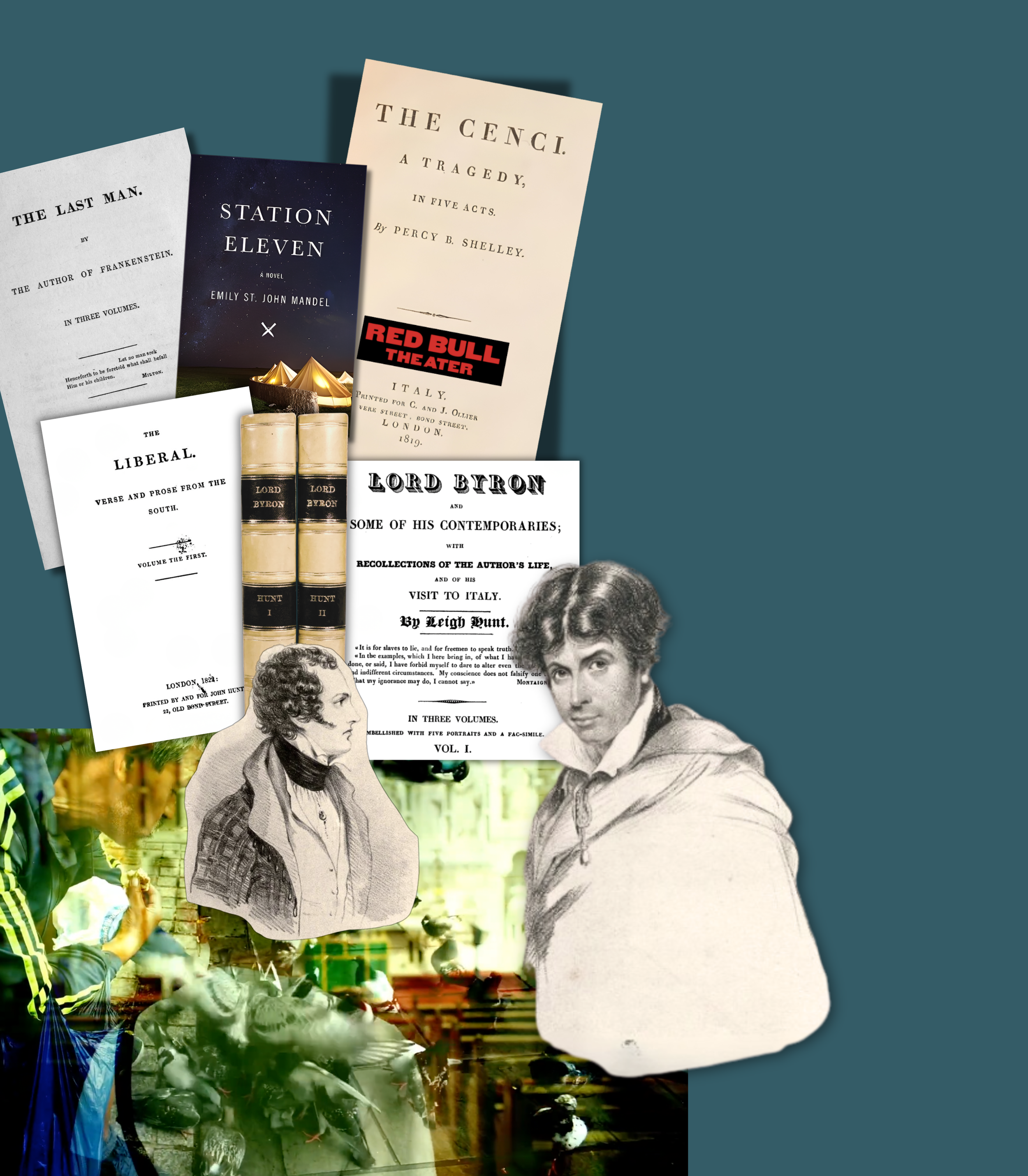
The K-SAA Members’ Meeting brings together scholars, students, and enthusiasts of Romantic studies for conversation, research sharing, and community building. Please join us to hear about our news and upcoming events: our collaboration with the Red Bull Theater for a fall performance of The Cenci (in-person and online), our recent Arts & Public Engagement winner Refuge from the Ravens, and our Fall 2026 Curran Symposium THE LAST MAN AT 200–Imagining the Future after Environmental Disaster.
We’ll follow these updates with a lecture that reconsiders the collapse of The Liberal, the journal experiment dreamed up as a collaboration between Percy Shelley, Leigh Hunt, and Lord Byron.
Drawing on a long view of the The Liberal project and its aftermath, this talk considers the broader stakes and possibilities that emerge when such ventures falter, offering fresh insight into the relationship between friendship, authorship, and the evolution of writing. Following the short-lived experiment of The Liberal, Hunt reshaped his career as he turned to new forms, culminating in Lord Byron and some of his Contemporaries—a work that not only challenged Byron’s public image but redefined the boundaries of biographical candor. Please see the full talk abstract below.
Current and future members are warmly encouraged to attend and take part in the discussion.
Not yet a member? We invite you to join the K-SAA and become part of a vibrant, international community dedicated to the study of Romanticism. Membership provides access to events like this one, as well as opportunities for collaboration, funding, and professional development.
Learn more and join us at: https://www.k-saa.org/membership
Nicholas Roe
“Leigh Hunt, Lord Byron, and The Liberal: some Causes and Consequences”
This paper takes a new long view at some causes of the Liberal project and some consequences of its failure after just four issues.
Much as abandoning the Examiner and Indicator meant that Leigh Hunt could go to Italy to produce the Liberal, not contributing to the Liberal meant Hunt was free to contemplate other projects including his controversial book Lord Byron and some of his Contemporaries (1828). Hunt's memoir proved 'liberal' in the sense that it was candid and, in the view of some readers, shockingly indiscreet. Nearly forty years after James Boswell documented his Life of Samuel Johnson with exhaustively ‘minute particulars’ Hunt was experimenting with a form of biography that was not aligned with Byron's popular image; daringly and dangerously, Hunt delivered a portrait of the 'noble poet' from a different angle, seeking to understand Byron's complex personality and how, in the post-Liberal fallout, Byron had impacted his own life. As editor of the Examiner Hunt championed independence, impartiality, and 'an unprejudiced spirit of thinking'; to the Liberal he contributed 'liberalities in the shape of Poetry, Essays, tales, Translations [in] the best interests of human nature'. To polish a flattering portrait of his former friend would contradict all of those journalistic ideals. Instead, Lord Byron and some of his Contemporaries offered a narrative that spurned panegyric and in so doing proved foundational for modern literary biography as championed by Lytton Strachey in Eminent Victorians (1918). I will conclude with one of Hunt's admirers, Virginia Woolf, who echoed Hunt's Lord Byron volume while praising Strachey's book in her 'Art of Biography' essay.
Nicholas Roe FBA, FRSE, FEA is Wardlaw Professor of English at the University of St Andrews. His most recent book is John Keats and the Perils of Posterity, published by Oxford University Press in 2025.